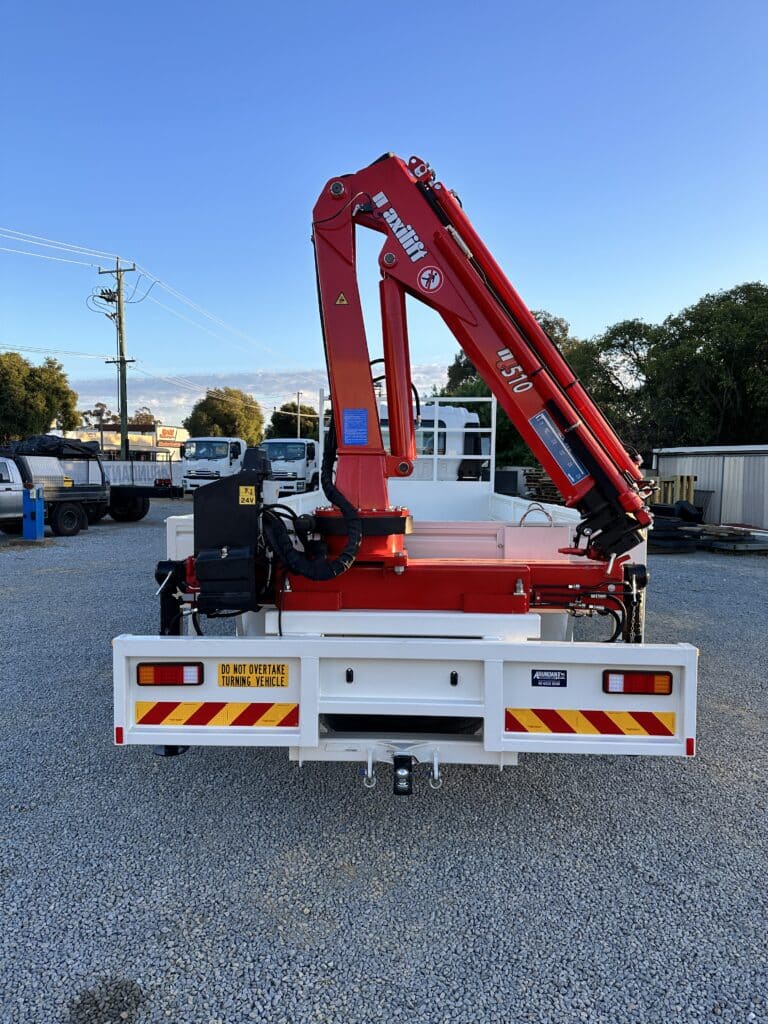
Your truck loading crane is one of the hardest-working pieces of equipment in your fleet. Day in, day out, it lifts, slews, and extends under heavy loads across every kind of Riverina worksite — from construction and civil jobs to agricultural loading and mobile workshop work. And like any hydraulic machine under constant stress, it gives you warning signs before it fails. The trick is knowing what to look for.
At Abundant Welding and Hydraulics, we service and repair truck loading cranes across Wagga Wagga and the surrounding region — Maxilift, Hiab, Unic, Cobra, and Tommy Gate units of all sizes. As an authorised Maxilift sales and service agent with 50+ years of combined welding and hydraulics experience, we’ve seen how catching a small problem early can save you from a major breakdown, an expensive component failure, or worse, a safety incident on site.
This guide walks through the five most common warning signs that your crane needs professional attention — before a minor issue becomes downtime you can’t afford.
Why Early Detection Matters
A truck loading crane that fails mid-lift isn’t just an inconvenience. It can drop a load, damage your truck, injure your operator or bystanders, and pull your vehicle off the road while it’s repaired. Beyond the immediate risk, a crane that isn’t running right costs you money every day it’s compromised — through slower cycle times, higher fuel use, accelerated wear on other components, and the ever-present risk of a compliance failure during inspection.
The good news is that cranes rarely fail without warning. Hydraulic systems, structural members, and control circuits almost always show symptoms before they let go. Learning to recognise these signs — and acting on them promptly — keeps your crane safe, compliant, and productive.
Start with your maximum Aggregate Trailer Mass (ATM)—the heaviest loaded weight your trailer will ever reach. Your towbar rating must exceed this figure, but going massively over spec’d adds unnecessary weight and cost. A 3,500kg ATM tipper trailer doesn’t need the same towbar as a 45-tonne B-double.
Sign 1: Hydraulic Leaks or Fluid Loss
Hydraulics are the heart of your loading crane, and leaks are the single most common sign that something needs attention.
What to look for:
- Oil pooling under the crane or on the truck deck after use
- Visible weeping around hoses, fittings, cylinders, and the slew mechanism
- Oil residue or dirt build-up clinging to hydraulic components
- Needing to top up hydraulic fluid more often than usual
- Streaks running down cylinder rams or boom sections
Why it matters:
Even a small leak points to a failing seal, a chafed hose, or a loose fitting — and hydraulic problems compound quickly. Low fluid causes the crane to lift slower, jerk under load, and run hotter, which then damages seals and pumps and turns a cheap repair into an expensive one. A hose that’s weeping today can burst under full load tomorrow, dropping whatever it’s holding.
What to do:
Don’t just keep topping up the oil. Have the leak traced to its source and repaired properly. With our Ryco hydraulics partnership and 24/7 mobile hose service, we can replace failed hoses and fittings on site and get you back to work fast.
Sign 2: Slow, Jerky, or Uneven Movement
A healthy crane moves smoothly and predictably. When lifting, slewing, or extension starts feeling off, the crane is telling you something.
What to look for:
- Boom that lifts slowly or struggles under loads it used to handle easily
- Jerky, stuttering movement instead of smooth operation
- Slewing (rotation) that catches, grinds, or hesitates
- Telescopic sections that extend or retract unevenly
- Load drift — the boom slowly creeping down when it should hold position
Why it matters:
Sluggish or jerky movement usually signals hydraulic issues — low fluid, air in the system, a worn pump, or a failing control valve. Load drift is especially serious: if the crane can’t hold a load steadily, a seal or holding valve is failing, and that’s a safety problem, not just a performance one. Uneven slewing can also indicate wear in the slew bearing or ring gear, which are major components you don’t want to run to failure.
What to do:
Have the hydraulic system and controls diagnosed properly. Our computer diagnostic connection lets us read faults directly from the crane’s system and pinpoint the cause rather than guessing.
Regional highway work is different from farm access tracks which is different from mine sites. Smooth highway running allows precision ball couplings. Rough farm tracks with constant articulation demand couplings with high-oscillation capability. Mine sites with severe service conditions need maximum-duty specifications even if the actual loads aren’t extreme.
Sign 3: Unusual Noises During Operation
You know how your crane sounds on a normal day. New noises are one of the earliest and most reliable warning signs.
What to look for:
- Grinding or crunching when slewing (often the slew bearing or gear)
- Whining or screeching from the hydraulic pump (frequently air or low fluid)
- Knocking or banging under load
- Clunking when changing direction, pointing to worn pins or bushes
- Squealing from cables or sheaves on wire-rope cranes
Why it matters:
Noise means friction, wear, or a component working harder than it should. A grinding slew bearing left unaddressed can seize or fail — and replacing a slew ring is a major job. Pump whine that’s ignored leads to pump failure and contamination through the whole hydraulic system. These noises are cheap to investigate now and very expensive to ignore.
What to do:
Don’t run a crane that’s making new noises under load. Book a service so the source can be identified before the component fails completely.
Sign 4: Structural Cracks, Wear, or Damage
The structure of your crane — boom, base, mounting, and pins — carries every gram of load. Structural problems are the most safety-critical of all.
What to look for:
- Cracks in welds, particularly around the base, king post, and boom pivot points
- Cracking or movement where the crane mounts to the truck chassis
- Excessive play or wear in boom pivot pins and bushes
- Bent, gouged, or deformed boom sections
- Elongated bolt holes or loose mounting bolts
- Rust or corrosion around structural members and welds
Why it matters:
Structural failure is the most dangerous way a crane can fail. Cracks start small at high-stress points and spread — and a crane operates its whole life at high stress. A failure at the mounting or boom pivot under load can drop the load and cause serious injury or death. This is exactly the kind of issue that a major inspection is designed to catch, and it’s why running an overdue crane is such a gamble.
What to do:
Structural repairs on a crane are not a DIY job — they require certified welding and proper engineering assessment. As welding and fabrication specialists, we can assess structural wear, carry out compliant repairs, and restore the crane to safe operating condition.
Sign 5: Control Problems or Erratic Operation
Modern loading cranes rely on control systems — remote or lever — that need to respond precisely every time. When the controls become unreliable, the crane becomes unpredictable, and an unpredictable crane is a dangerous one.
What to look for:
- Remote control lag, dropouts, or intermittent response
- Functions that activate on their own or don’t respond when commanded
- Warning lights or fault codes on the control display
- Overload warning systems triggering incorrectly (or not at all)
- Emergency stop not working as it should
Why it matters:
Control faults directly compromise operator safety. If a function activates unexpectedly or the overload protection isn’t working, the operator can’t trust the machine — and a crane you can’t trust shouldn’t be on a job. Fault codes are the crane’s own diagnostics telling you something specific is wrong; they shouldn’t be ignored or reset without understanding the cause.
What to do:
Have the control and safety systems diagnosed. Our diagnostic connection reads fault codes directly, so control and electrical issues can be traced accurately rather than by trial and error.
Don’t Wait for a Breakdown
Every one of these warning signs shares the same lesson: cranes give you notice before they fail, and acting on that notice is always cheaper and safer than waiting. A crane that leaks, drifts, grinds, or throws fault codes is a crane telling you it needs attention. Ignoring it turns a scheduled service into an emergency breakdown — usually at the worst possible time, mid-job, with a truck out of action.
Regular preventive maintenance and prompt attention to warning signs keep your crane running safely, extend its working life, and protect you from compliance failures during inspection. It also keeps your operators safe, which matters more than anything else.
Why Choose Abundant for Your Crane Service
As an authorised Maxilift sales and service agent, we service and repair all major truck loading crane brands — Maxilift, Hiab, Unic, Cobra, and Tommy Gate — across Wagga Wagga and the Riverina. Our combination of hydraulics expertise and certified welding and fabrication capability means we can handle everything from a weeping hose to a structural repair, all in-house.
Our crane services include:
- Scheduled preventive maintenance programs
- Hydraulic system servicing and repairs
- Computer diagnostic connection for accurate fault-finding
- Component replacement and certified structural repairs
- Annual safety inspections and major inspections to AS2550.11 and AS1418.11
- Load testing and certification with crane tags
- Emergency breakdown response and mobile service
With our diagnostic equipment, Ryco hydraulics partnership, and mobile service capability, we get your crane back to safe, productive operation with minimum downtime.
Book Your Crane Service Today
If your truck loading crane is showing any of the warning signs in this guide, don’t wait for it to fail on the job. Our experienced technicians can assess its condition, diagnose any issues, and carry out the repairs or servicing needed to keep it running safely and compliantly.
Phone: (02) 6932 6500
Email: info@abundantweld.com
Visit: 2 Dobney Avenue, Wagga Wagga NSW 2650
From routine servicing to emergency breakdowns and major inspections, we keep the Riverina’s truck loading cranes lifting safely. Get in touch and we’ll help keep yours working.